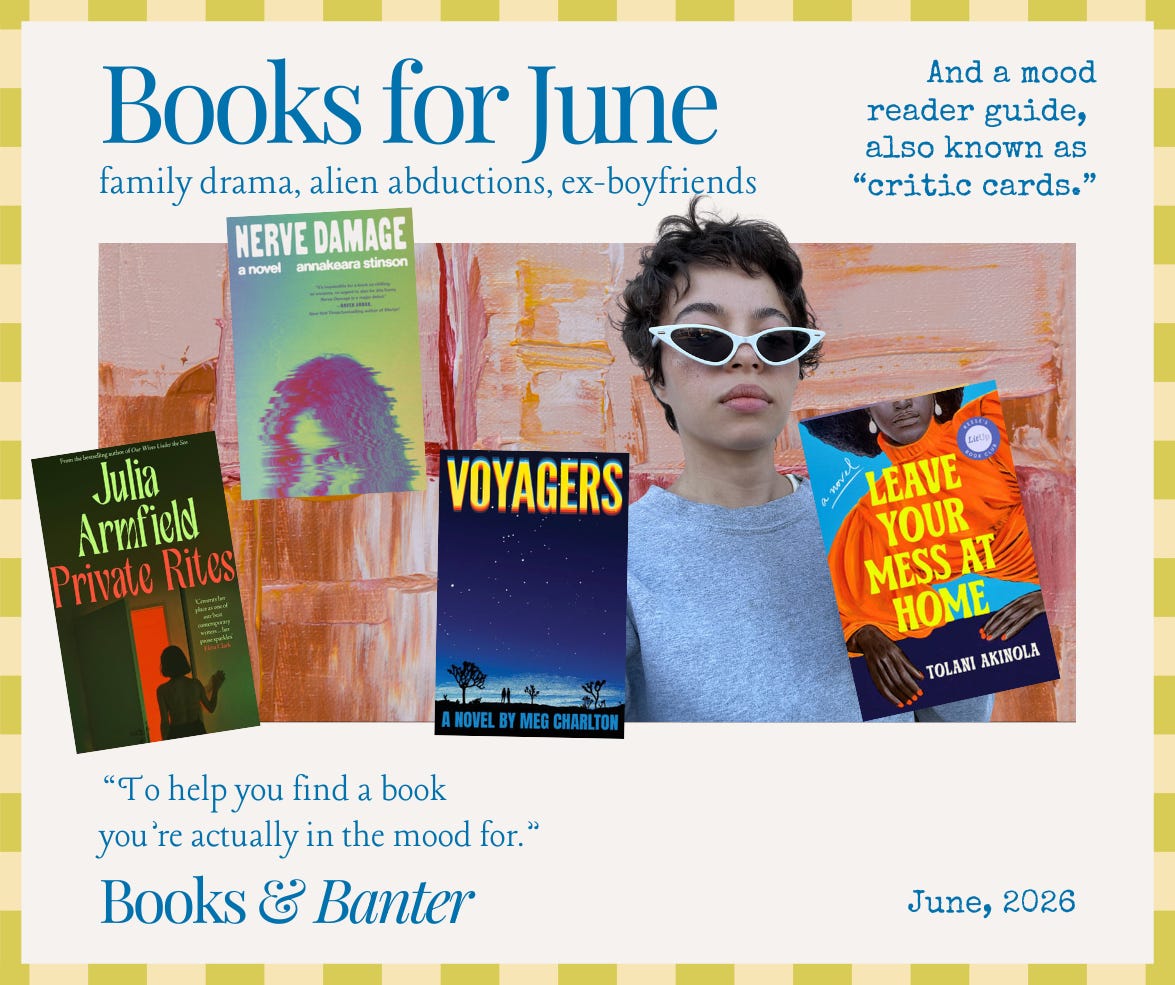
Books for June
family drama, alien abductions, ex-boyfriends
Hi dearest reader,
Let this be your official notice: slow-burn books are back! Today’s recommendations take their time with you, yet result in a satisfying surprise. More of this please. June is a month of literary books with exciting plots and clever speculative elements, leaving you with deep feelings about what it’s like to be human today.
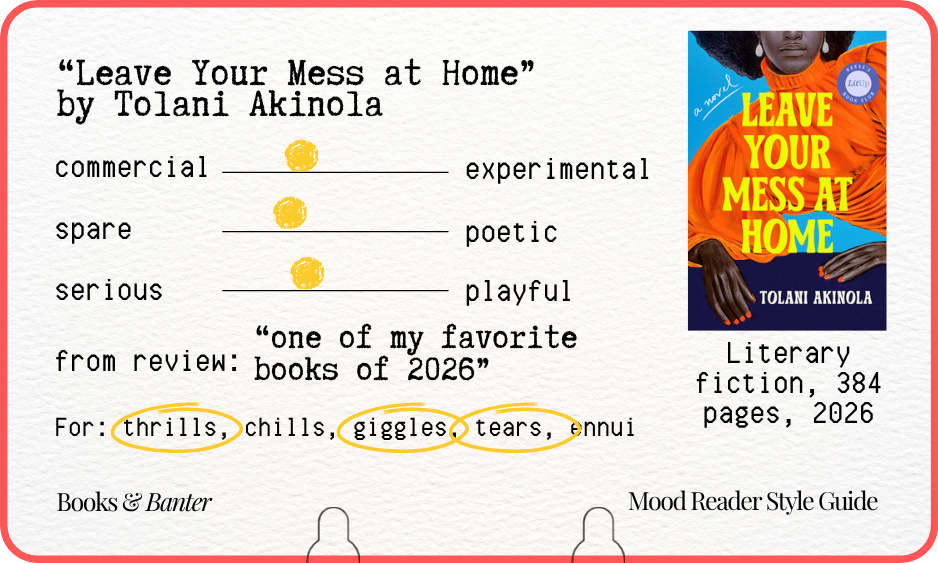
Leave Your Mess at Home by Tolani Akinola
Literary fiction, 384 Pages, published in April, 2026.
My siblings and parents and I often have different memories of the same event, sometimes to the point we accuse one another of making their version up. “That didn’t happen!” Or “I don’t remember it like that.” Sometimes the dissonance is charming, other times it’s a frightening schism between us.
Before reading Leave Your Mess at Home, it used to frustrate me that we couldn’t inherently understand each other’s lived experiences simply by being related. If we could do that, then there’d never be any conflict and everything would be hunky-dory. But reading Leave Your Mess at Home has changed that (unfair) desire I have for my family members to inherently be in tune with one another. Akinola suggests that these relationships take work and intention, it takes a mindful practice to pay attention and create a space to understand one another’s wildly different lives. And equally so, it takes accepting that we’ll always be distinct.
The four siblings in Leave Your Mess at Home are Sola, Ola, Anjola, and Karen. They’re each in the middle of their own unknowable struggle, that is until an exposed secret forces them to reconcile their differences.
In Leave Your Mess at Home, Akinola masters the character arc. And for me, the best part about the novel is its genius portrayal of how mothers can raise sexist sons. Here, Akinola provides incredible nuance. I imagine Bell Hooks would be so proud of this book!
Clever, tender, and thrilling, Leave Your Mess at Home is one of my favorite books of 2026! Plus it’s a super engaging audiobook; I explain how it had me screaming in this podcast episode here.
The ideal mood for reading Leave Your Mess at Home:
It’s been too long since you’ve had a steaming hot cup of tea!
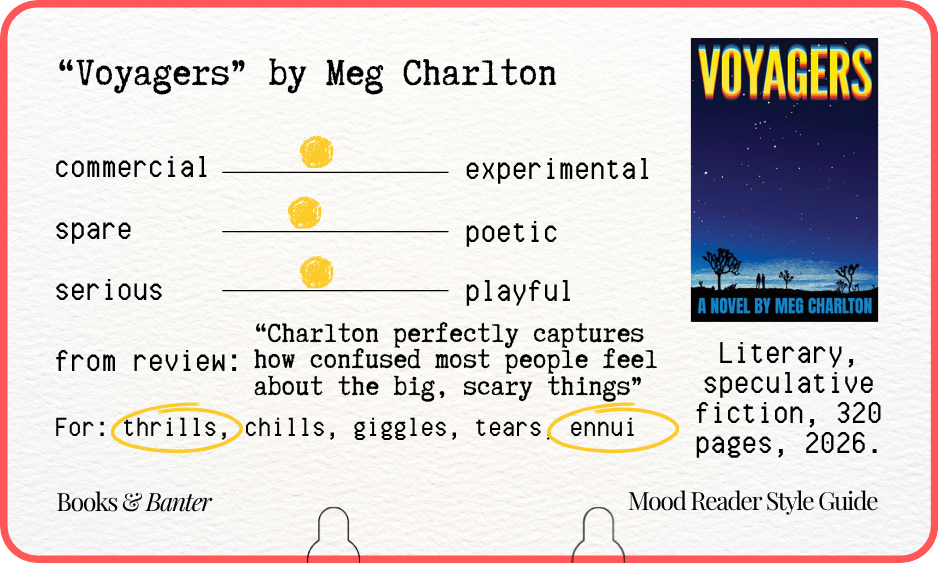
Voyagers by Meg Charlton
Literary fiction, speculative, 320 pages, out June 16th, 2026.
Alien abductions were a hot topic in the late 1900’s, perhaps peaking in the 1990’s with the iconic show X-Files, starring Gillian Anderson and David Duchovny.
In the world of Voyagers, Alex and Ana, are forged in the fire of daytime television alien conspiracies. In 1998, when they’re children, they go missing for two days in the desert, and when they’re found and interviewed on the news, it’s presumed they’d been abducted by extraterrestrials. The fallout is years of fame as they become poster children for alien abductions, spending a lot of time at UFO conventions.
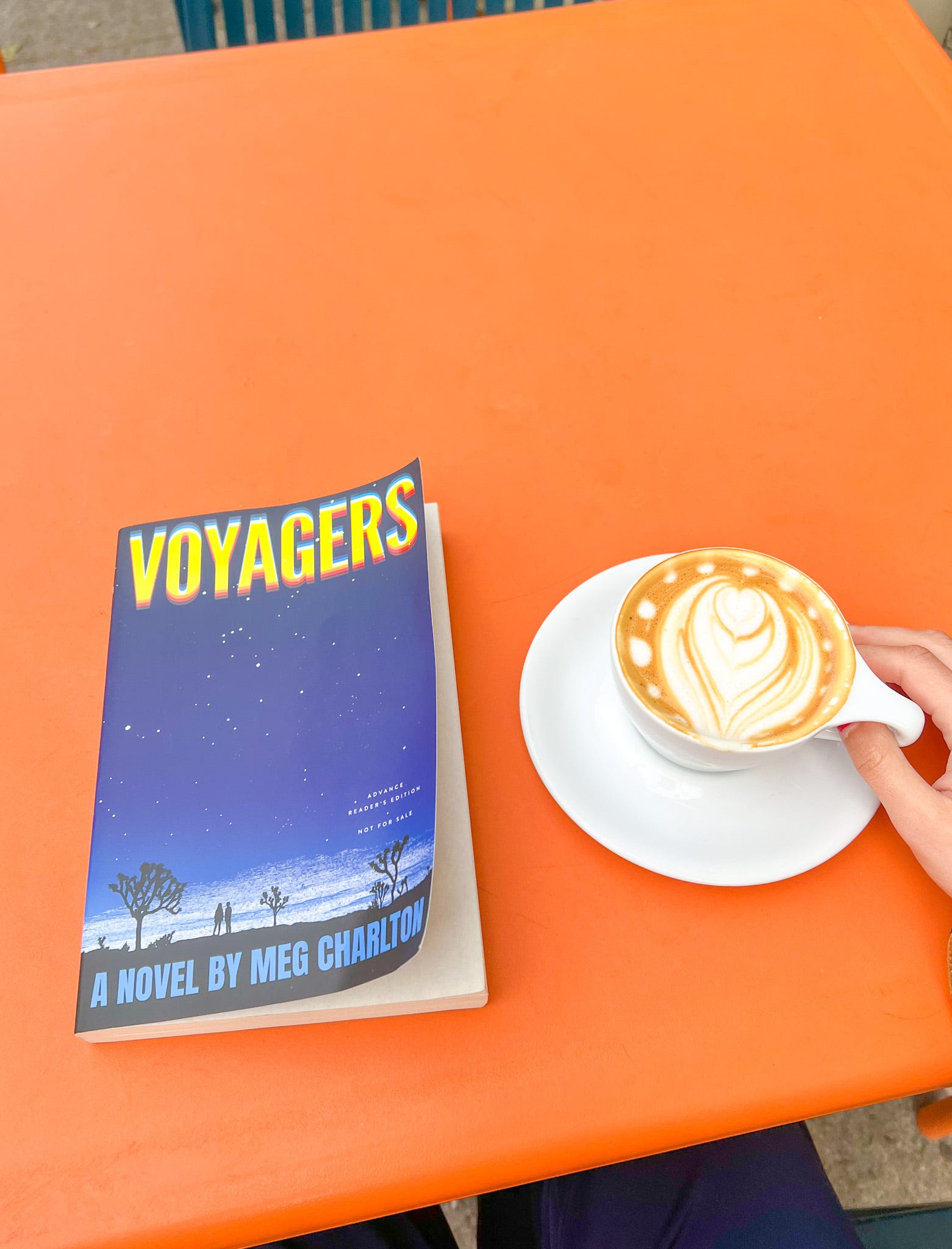
Voyagers is told from the perspective of Alex all grown up, yearning for his estranged friend Ana. He lives a humdrum life as an attorney, but not for long. Because—here’s the cool thing about this book—a sci-fi element appears and has us thinking deep about friendship, belief, memory, and the stories we tell ourselves to feel better.
A strange signal arrives in the solar system and it’s headed straight for Earth. As it gets closer, odd things begin to happen.
What excites me most about Voyagers is Charlton’s clever narration. She purposefully keeps the reader as confused as Alex about the big unknown universe. When the mysterious signal moves through our solar system, and the United States blames foreign governments in an attempt to distract (because of course they would) and the people come up with their own conspiracies, we don’t know what to believe. And right there, not knowing what to believe, is the finer point of Voyagers.
After reading I realize now, Charlton perfectly captures how confused most people feel about the big, scary things that happen to us that we can’t control. It made me think of the Covid-19 pandemic because even though during the height of it we intended to be scientifically minded about the virus, obsessively turning to data as a source of protection, I imagine most people felt much more confused and out of control than that and so turned to stories that were easier to understand.
I found myself frustrated that Alex didn’t have access to data about the signal that could explain what it was doing and where it came from. So then I had to acknowledge that this constant state of mystery is how humans have had to function for their entire existence. As somebody who largely makes decisions based on evidence, who basically fact checks every piece of information I’ve ever heard, I really had a hard time sitting with this truth. And ironically, in the end, I felt validated to linger in that unknown. It was a validation I didn’t know I needed. How wonderfully human it is to do our best in a world that hardly makes sense.
The ideal mood for reading Voyagers:
You miss your best friend.
More in the zine


More of June’s book recommendations can be found in the Books & Banter zine No. 3, because nothing beats reading in print. :) Also in the zine is an activity to build your summer reading list. If you missed the cut-off last month, here’s an opportunity to grab one of these. Enjoy!
Love,
Amani

In case you missed it, you can listen to last week’s wins & woes podcast episode here.