

Books for May
bogs, love affairs, oil tycoons

Hi dearest reader,
For some of the book recommendations today I offer fun facts about the special interests explored in the story. Over here we love to do research after a good book. For knowledge! For wisdom! For author appreciation! I hope today’s newsletter will be a nice accompaniment to the mini-reviews in my zine this month.
I’m picturing you can flip through the zine and then dig deeper with the subject of a book that caught your eye here on Books & Banter.
Stinky, Muddy Bogs!
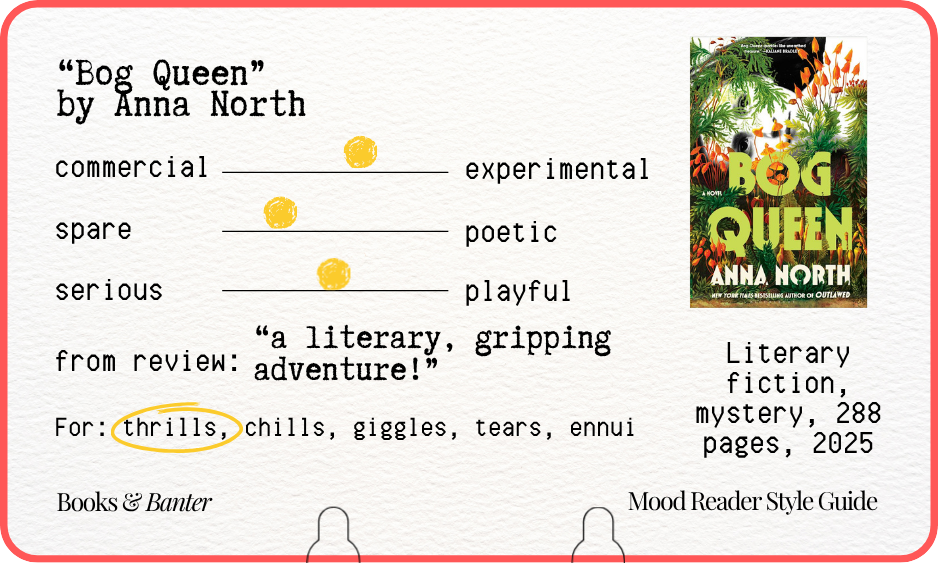
Bog Queen by Anna North
Literary fiction, mystery, historical, 288 pages, 2025
I love a good bog. Also know as: nature’s mummification. Also known as: where the wild things wiggle.1
Plus, I love a good murder mystery about forensic science. Also known as that show Bones. Also known as women in their twenties investigating what went wrong in their relationship.
Here enters Bog Queen, a novel for nature enthusiasts and mystery buffs alike. (Are you raising your hand? I am.)
Anna North’s novel is imaginative and mesmerizing. You’re telling me we get to read a story about a druidic Celtic woman thousands of years ago AND we get fun facts about peat moss???
Bog Queen is set between two timelines. We have the present day with a main character named Agnes, a forensic anthropologist from America tasked with solving a murder—no wait they found another body in the bog—make that two murders.
Then, we have a past timeline set thousands of years ago, from the perspective of that same woman they found in the bog, the Celtic druid. A druid who gets embroiled with the political scheming in England during the rise of the Roman empire…But does Agnes know this? Not really.
As Agnes studies the mummified remains of the druid, hoping to get a clue about the cause of death, she also truly does investigate her own past and what went wrong in her romantic relationship after college. Furthermore, she’s challenged by the present day climate risks and human exploitation of the bog she investigates.
Now that I’ve described this, it’s clear we should all be impressed by Anna North. She made several complex ideas and storylines easy to read. It’s a literary, gripping adventure!
Bog Queen is a love letter to the ecosystems we take for granted. I’ve come away from North’s novel feeling like I have more knowledge than I did before. What a treat of peat.
The ideal mood for reading Bog Queen:
You have the urge to solve a puzzle.
Dominion by Addie E. Citchens
Literary fiction, 240 pages, 2025
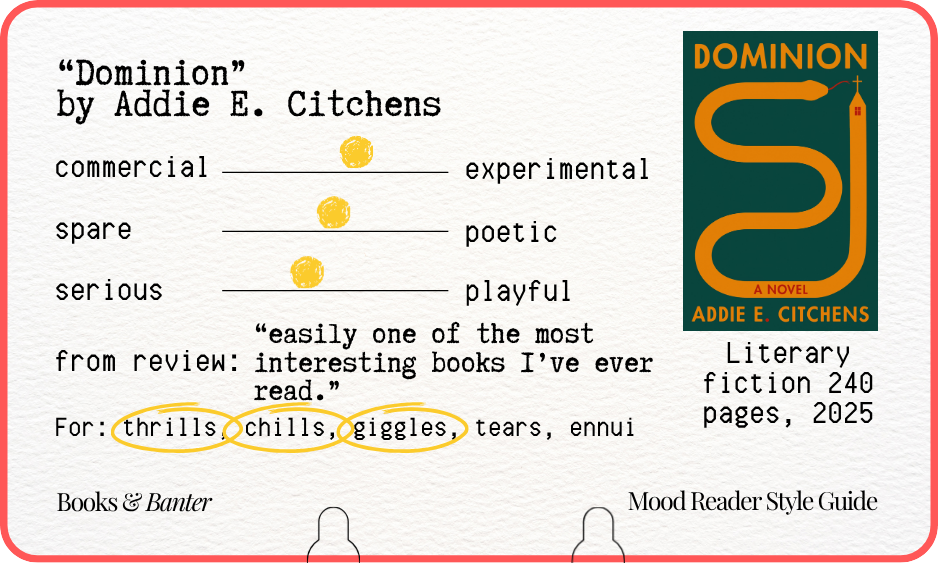
Truly, genuinely, Dominion is one of those novels you should go into knowing nothing. Enjoy letting the author take you where she wants to go. Citchens is a superstar writer. I hope Dominion wins the 2026 Women’s Prize For Fiction. It was shortlisted but we won’t find out who wins until June 11th.
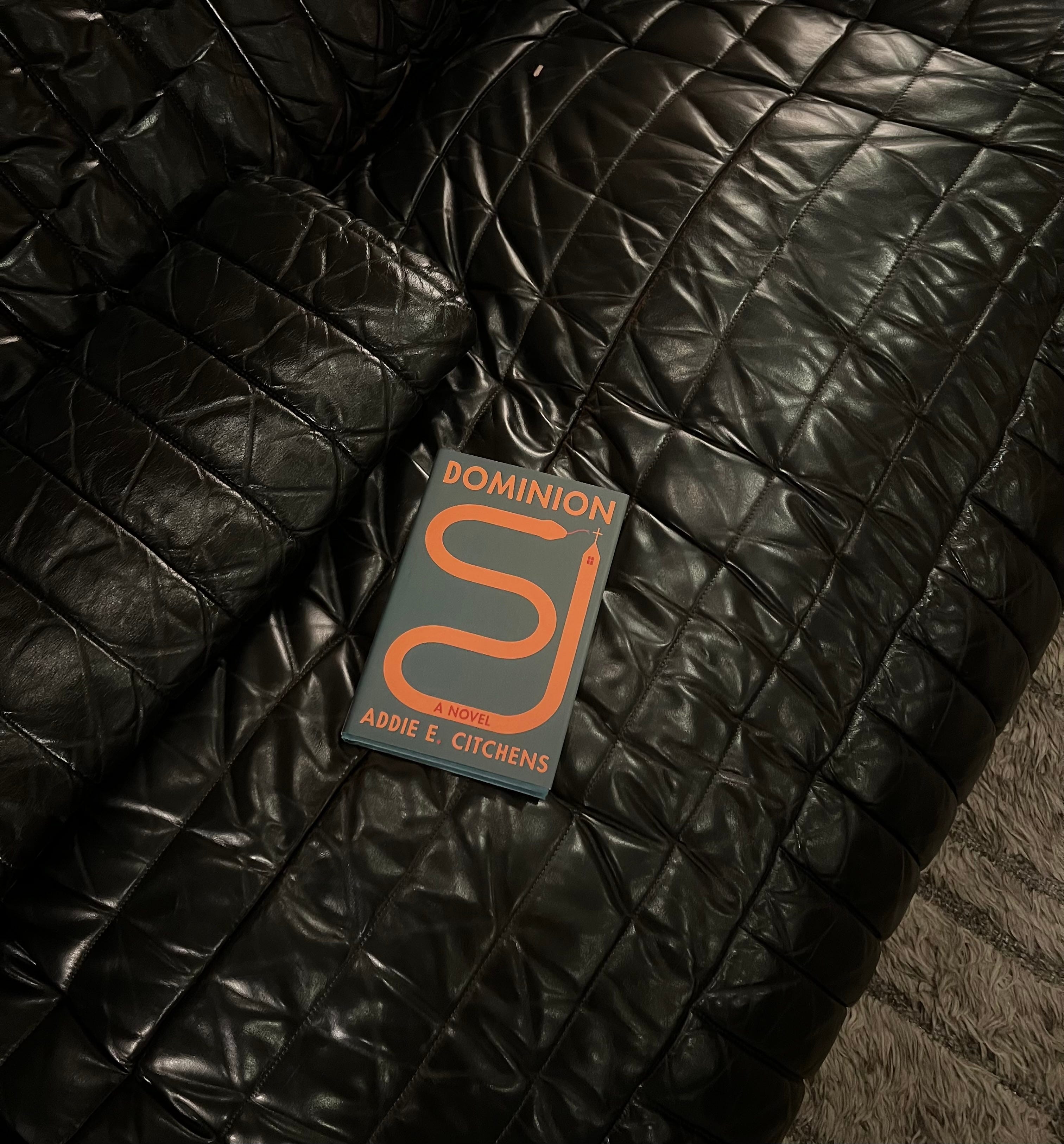
Dominion is easily one of the most interesting books I’ve ever read, sophisticated in how we shift between the two main characters, Diamond and Priscilla, knowing more about how they view one another than they do.
So very suspenseful, even frightening because we know what some of the characters are capable of. I swear, it’s like every few pages there’s a surprise! Ahhh! Citchens takes us there! It’s inspiring the way she writes with self-possession and freedom, doing exactly what she wants to do with the story.
Dominion tackles misogyny and capitalism in religion with fresh wit and narrative ingenuity. The girls and boys are not alright. It’s a book entire essays could, and should, be written about. Not only that, but the language here is original and hilarious. When I was finished reading Citchens’ novel, all the other books seemed dull. I super duper, highly recommend. Dominion is an outstanding work of art.
The ideal mood for reading Dominion:
You need a good excuse to cancel your plans.
Loved One by Aisha Muharrar
Literary fiction, 336 pages, 2025
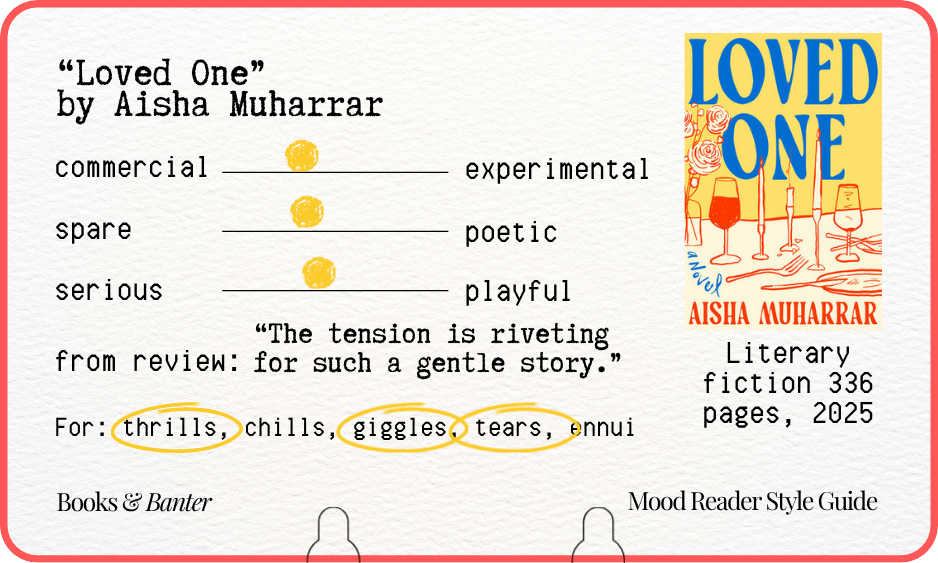
This is a comforting novel about lost love, told with great wit and sensitivity. I listened to Loved One while folding zines for the Dearest Reader Club, then picked up a hardcover at the SFO airport on the way to Santa Monica and carried it around the hotel as you can see below, ha! (I offer tips on shopping for books at the airport in May’s zine.)
Loved One soothes a sore heart while taking you on an adventure to London, as the titular character Julia—somewhat chaotically—tracks down the ex-girlfriend of her late friend, Gabe, so as to snatch his belongings that are meaningful to her.
Gabe was Julia’s friend and former love. And as a famous musician, he died too young and under suspicious circumstances. But before he suddenly died, it’s possible Julia and Gabe had loved each other while Gabe and his ex, Elizabeth, were together…and perhaps even longer than that…so…!!! The tension is riveting for such a gentle story.
Julia and Elizabeth become an unlikely pairing as they dig through their complicated, love-filled memories. Have you ever heard of a buddy comedy? With Loved One, Muharrar invented the buddy tragedy. Immediately, I need more. What could be more relatable than sharing the loss of a loved one with another person?
Muharrar is clever, funny, and incredibly moving. Hats off to Loved One, this is how you make a quiet plot interesting.
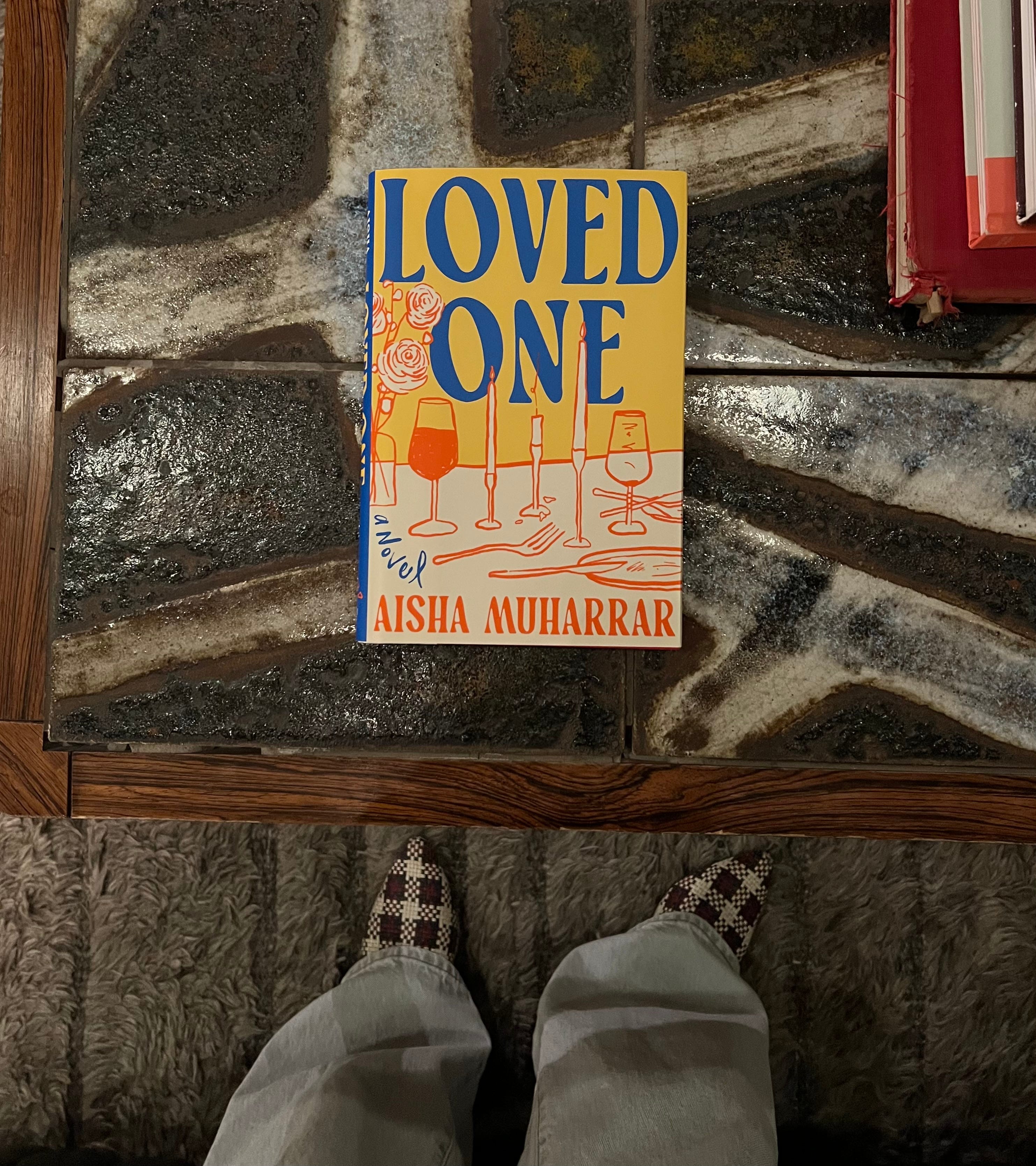
The ideal mood for reading Loved One:
You need to mellow out with a tender but intriguing story.
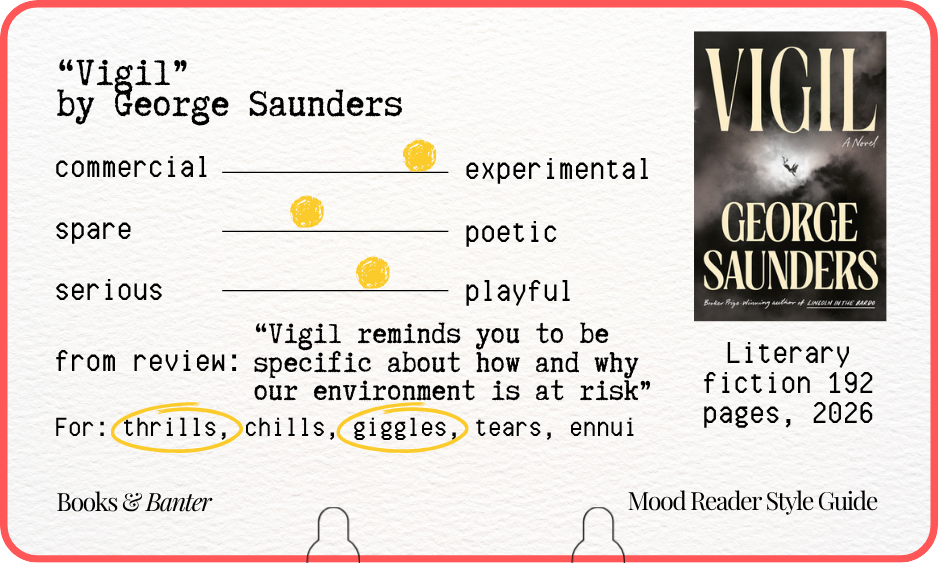
Vigil by George Saunders
Literary fiction, speculative, gothic, 192 pages, 2026
Super fun fact: the fossil fuel industry knew that burning their products harmed Earth’s climate as early as 1954. And worse still, people in the industry used money and misinformation to squash the truth, mislead regulators, and prevent course correction.2
Wow…Awesome.
This is a “fun” fact I learned thanks to Vigil by George Saunders in which a cantankerous oil tycoon named K.J. Boone possibly throttled climate science in favor of his industrious greed. He’s not a cartoonish Scrooge, he’s more of a complicated man, as much as I wish he wasn’t. He is, as Saunders tells it, a product of his upbringing. The first question Saunders leaves me with: what’s wrong with our culture that it would create such a man of destruction by such banal methods as corporate servitude? I’d argue K.J. Boone is an updated rendering of “the banality of evil”3 for contemporary America.
With a little research I followed Vigil’s premise to a Guardian article describing the foretold “smoking gun proof” of what oil and car manufacturers knew 70 years ago:
“Experts say the documents show the fossil fuel industry had intimate involvement in the inception of modern climate science, along with its warnings of the severe harm climate change will wreak, only to then publicly deny this science for decades and fund ongoing efforts to delay action on the climate crisis.”4
Vigil reminds you to be specific about how and why our environment is at risk; fossil fuel corporations aren’t mystical concepts, they’re run by flesh and blood people with enormous budgets. Who’s at the top making these decisions to squash science or transfer blame5?
In Vigil, K.J. Boone is one of these people. But far from his heyday, the old man is dying now.
Set over a single evening, in the bed of his luxurious mansion, we watch K.J. die in slow-motion. The entire story is miraculously told from the perspective of a human-spirit-angel named Jill, charged with comforting the dying in their final hours.
Jill “Doll” Blaine, what a sweetheart, is a woman with a to-do list. She herself died too soon and under suspicious circumstances—another mystery the story unravels. It takes the persistence of Jill for K.J. Boone to face his life before death. He can’t seem to absolve himself in his passing because he has no remorse for what he’s done. Like the banality of evil implies, he won’t for the life of him decenter himself. He doesn’t imagine what other people (and plants and animals and ecosystems) are experiencing due to his actions. All he can think about is how good he was at his job.
Is it too late for K.J. to find absolution? Will Jill unravel the mysteries of her own death along the way? After reading Vigil, I couldn’t help but imagine a world in which the players responsible for this merde climate crisis suddenly observe the value of our planet and decide to reverso Uno6 their goals, instead using their ruthless ambition to right their wrongs. This is a dream I have. Can you imagine? It’s kind’ve funny to picture. Well guess what, Vigil is hilarious too.
But please, let me dream.
The ideal mood for reading Vigil:
You need a laugh as you pace around the room.
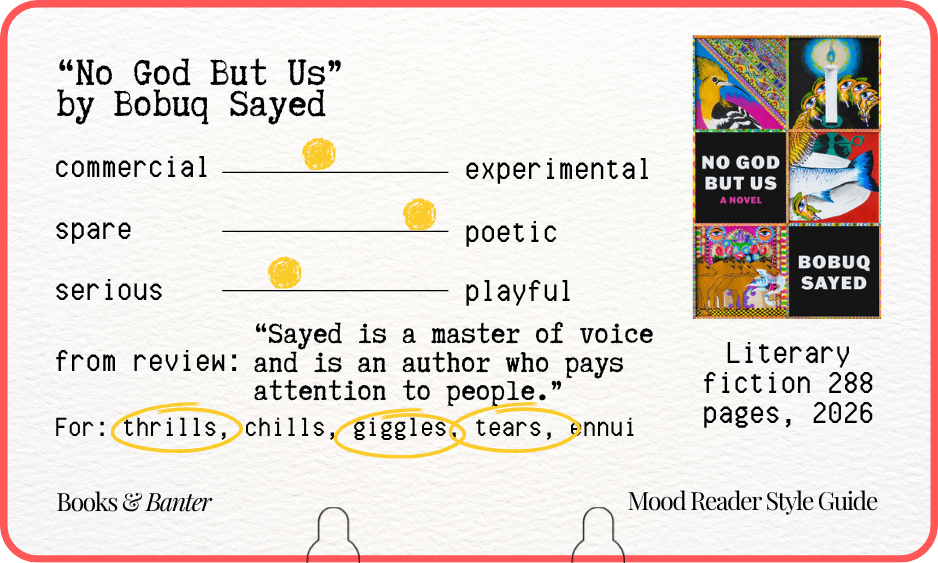
No God But Us by Bobuq Sayed
Literary Fiction, 288 pages, ✨out May 26, 2026✨
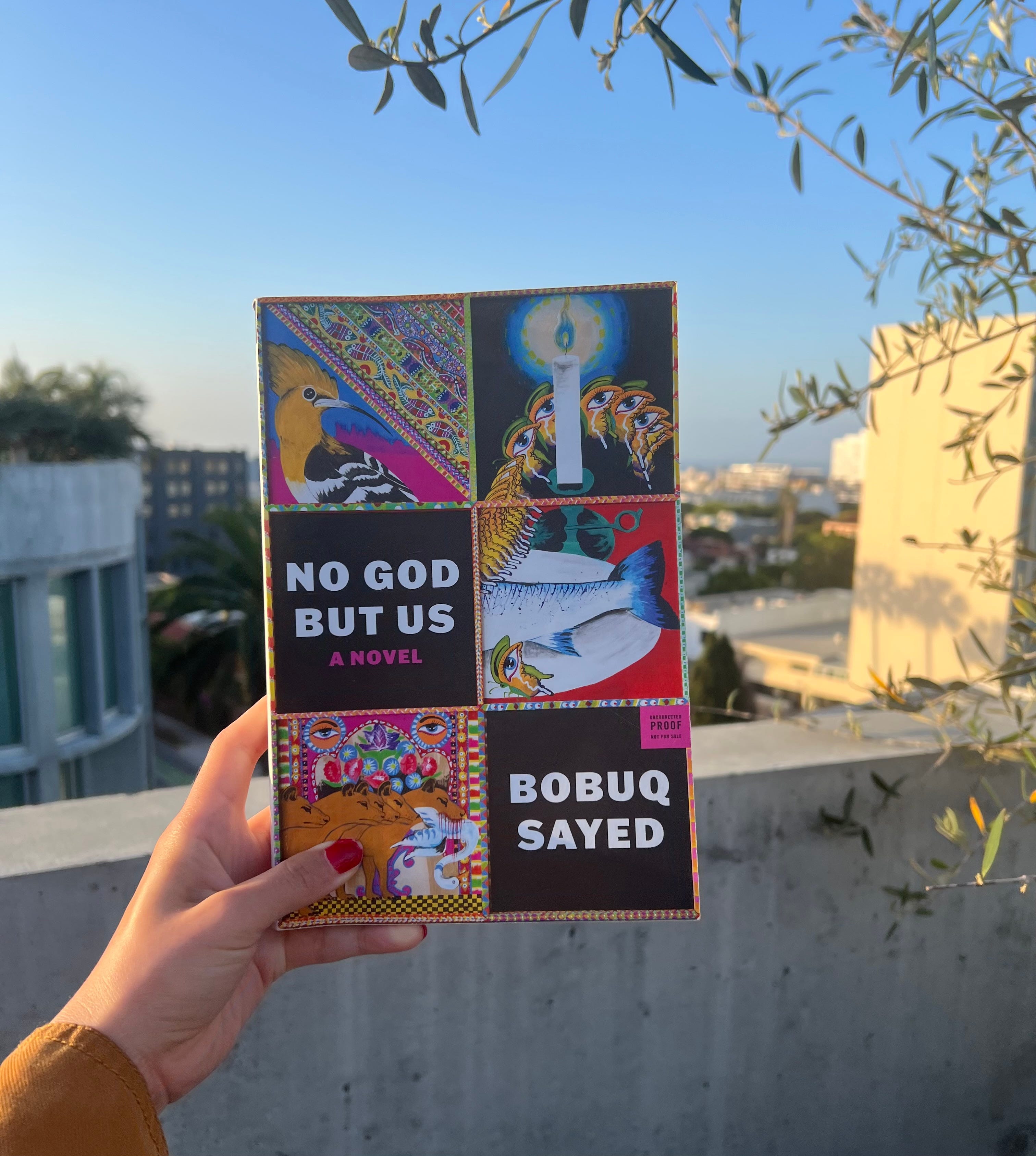
Effervescent, moody, and bold is how I’d describe Sayed’s debut novel, No God But Us. The opening few chapters are especially beautiful, somehow reminding me of a 90’s indie film about people meeting briefly in the night and irrevocably changing each other’s lives. This book is actually set over a few years from 2013-2019. I beg the powers that be to adapt this into an indie film. It’d be legendary in a cinema format too.
No God But Us is a painful, searching story with plenty of humor. About two gay Afghan men, Delbar and Mansur, who’re fated to meet in Turkey while seeking refuge. In an escapist fashion, Delbar flees to Turkey from Washington, DC, after his family discovered photos of him in drag. Meanwhile, Mansur arrives by way of Iran where he had to leave his family behind.
Delbar is practically on vacation in Turkey, staying with his aunt and cousins for free while figuring out what to do next. Mansur is barely scraping by, staying in a hostel-type situation that isn’t entirely safe. Sayed did a beautiful job interweaving their perspectives and different experiences being in Turkey with an American citizenship versus with refugee status. But also, what was moving was the kinship Delbar and Mansur feel for the first time meeting somebody like themselves. For Delbar, Mansur is the first gay Afghan man he’s met, and as their relationship blossoms, so do they both.
Through the group of friends they make who’re also refugees like Mansur, and all the countries we hope will be safe for them despite the prejudices they’ll undoubtedly experience, it’s clear that finding home where queer people and refugees are respected is tremendously difficult. In the background, Turkey sizzles with potential conflict. Before reading No God But Us, I didn’t know much about Turkey’s rising conservatism and homophobia. The story explores the very real danger of attending a Pride parade in Turkey, where people can be arrested by police. “Once a lively affair with thousands of marchers, Istanbul Pride has been banned each year since 2015 by Turkey’s ruling conservative government” (The Guardian).7
While No God But Us isn’t a happily-ever-after kind of love story, justifiably leaning more towards cynicism, it is a story overwhelmed with love and kinship. Sayed is a master of voice and is an author who pays attention to people. The language is fresh poetry and the story is unapologetically human.
The ideal mood for reading No God But Us:
You’re hungry for lyrical sentences.

If you want a zine version of this newsletter I’m releasing a few copies you can get as one-offs for anybody who wants to read in print but isn’t a member of the monthly mail club yet: check it out here. That’s it for now!
Love,
Amani
In case you missed it, here’s last week’s wins & woe:

Footnotes:
“The Secrets of Ireland’s boglands”: “From ancient bog bodies to buried treasure, supernatural sprites to 5,000-year-old butter, the bogs of Ireland’s Hidden Heartlands are full of mysteries…Their construction is straightforward, though time-consuming: over thousands of years undecomposed plant material forms a thick and almost impenetrable layer of peat that progressively grows. The upper surface is then colonised by species such as moss, and the raised bog flourishes.”
“‘Smoking gun proof’: fossil fuel industry knew of climate danger as early as 1954, documents show”: “‘There is overwhelming evidence the oil and gas industry has been misleading the public and regulators around the climate risks of their product for 70 years. Trusting them to be part of the solutions is foolhardy. We’ve now moved into an era of accountability’” (The Guardian).
“How Hannah Arendt developed the concept of ‘the banality of evil’”: “Hannah Arendt came up with the concept of “the banality of evil” during her coverage of the 1961 trial of Adolf Eichmann. During the trial, Eichmann, one of the main organizers of the Holocaust, insisted that he was only obeying the law and following orders. Arendt interpreted this evil as having been normalized through law and bureaucracy: ‘There’s simply the reluctance ever to imagine what the other person is experiencing. That is the banality of evil’” (PBS).
“Fossil fuel companies finally accept the climate crisis – just not their role in it” (The Guardian). The audacity for fossil fuel companies to turn the blame onto the general public when, as described in the article of footnote #1, they themselves discovered how CO2 would negatively effect the globe with research that they did in the 50’s.
Yes, hi. I’d like to play the Uno reverse card on all this climate crisis stuff, thank you.

(Here’s a wiki about how the card is played in the game Uno.)
i've just started no god but us and loving it so far !! also i recently stumbled upon the bog queen so i'm glad to see your ringing endorsement
AHHHHHH